Beata Leyland
Business Owner & Author of this article
It's almost a taboo topic to say that an employee will have a transition period before becoming freelancer and later business owner.
Intrigued ?
I have similar traits with many of my clients.
One of them is ambition and drive for success but another one is background.
Many started as employees and got burned out and sought alternatives. They are fighters; they don’t give up and neither do I as I spent almost 15 years working for others and at a certain point, I simply couldn’t fight with my nature anymore.
It’s almost a taboo topic to say that an employee will have a transition period before becoming freelancer and later business owner.
I’ve called it here taboo as with whomever I’ve spoken all face the same struggles.
Many apply the very harmful assumption that it’s kind of embarrassing to talk about it as we should naturally figure it out, right?
We are in an eternal transition period in life in one way or another and embracing it makes us stronger.
Let me share /debunk the myths, and harmful conceptions which keep so many talented and capable people static.
As an employee you were/are used to dealing with very different types of people, styles of work, cultures and here is no difference.
I would even say that the fact that you know how to stand colleagues which you truly despise helps so much!
Same as knowing how to be a good team player and fit into different setups.
We cannot solve our problems with the same thinking we used when we created them.Albert Einstein
At the beginning you can expect dealing with people who might try to scam you!
Why I mention this is that many people are discouraged by that or have the wrong attitude towards it.
When you are new you are an easy target for scams, but after a few reviews you will stop to be a target no worries, simply ask questions and all will be fine.
I do truly respect all my clients’ past and present and not all of them were the easiest people to work with, but I also understood that there are people whom I can’t help.
One of my first clients was a campaign which failed and not because I did bad work, simply the results were so good that he didn’t know what to about it, and he became indecisive.
Some of my clients taught me a lesson about communication, where to set boundaries, how to communicate better (especially with people who need summary which is less than 1 min for a very complex task).
What is great is the fact that both parties (you and your client) can resign from cooperation at any moment. It’s very liberating, although I would put here a huge disclaimer to don’t mistake work relations with private relations as your clients don’t have to agree with you or be like you.
If you become friends overtime, great, nothing bad about that.
A major reason for ending contracts for me was the fact that… the work was done, or after delivering results reality check shown that my client’s project must be redefined or postponed, or was too risky from the financial point of view.
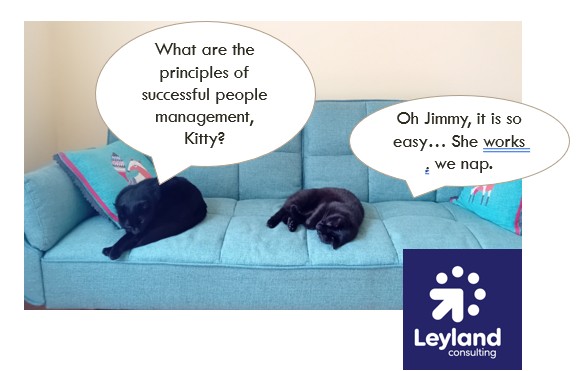
Huge part of people management is about active listening, asking questions and trying to understand the end goal of your client.
Imagine if he/she is a risk taker and risk mitigation should be there but not so pronounced or risk mitigation must be everywhere.
Although not all campaigns were successful, I always got good reviews, exactly because I knew when to speak and when to let my client or supplier shine.
People Management is also about managing all emotions, putting ego aside and adjusting to situations.
BE A PROBLEM SOLVER NOT PROBLEM CREATOR
Being “easy to work with” is a huge skill but for every person, project it might mean something different because for very risky projects being a bad policeman can be the best what you can do.
As a part of a team or community, fitting in is valuable — but there’s an important asterisk: you don’t have to fit in if it’s clearly not your group. Throughout life we move between different groups, and that movement is called progress.
When you leave one group (Group A) and choose another (Group B), your choice can be used as feedback. Group A can choose to reflect on it — or they can choose to blame you. But what does that have to do with you? Not much. People who avoid growth may resent your desire to explore what Group B offers. That’s their issue, not yours. You don’t have to apologise for leaving. You can simply say a respectful “ciao” to Group A.
A huge part of it is that we are conditioned to over-apologize, to compensate Group A for their loss, and to make sure everyone still likes us “just in case.”
The truth is that it usually is a personal habit rather than a responsibility. You don’t need to explain or over-explain yourself. No means no.

I learned to stop people-pleasing gradually, but my biggest lesson came from freelancing where I caught myself blaming myself for not delivering “enough” to a client who had actually received more than enough but simply could not handle their own success.
As a young freelancer, I assumed the problem must be me instead of seeing the bigger picture.
Zooming out is a valuable skill worth practicing daily.
This kind of self-reflection helps us recognize our own faults, our ego, and our areas for improvement.
It also helps us notice when some clients need not only results, but also clearer communication: questions about the concept of their project, genuine interest in their context, or a better understanding of the bigger picture — without trying to solve their problems for them.
To keep clients happy and build strong relationships, you need to do great work, be empathetic, suggest solutions, and listen — but don’t overdo it and don’t over-explain yourself.

When you
have worked more than you can handle,
experienced unjustified criticism from clients,
but got through it and learned to keep your head up high no matter what, then your future plans start to develop differently.
You become waaaaaayyy more strategic like a cat which hunts pray.
I clearly see now that being strategic is part of self-respect but also respecting others and their time.
All of us have the same 24h every day and it is up to us how we will spend it, what must be done, what can be postponed, what is a productive procrastination, and what is not important at all.
I still want time for myself, my family, friends. I need time to recharge from work and although the everyday ratio of off time might be different, the key is to make sure my main goal is to be/stay sane, keep cool and don’t allow the craziness of the outside world to hit me too much.
 Call us,
 Text us,
 Book a Consultation
We work on the global clock
Book a Consultation
We work on the global clock 