
Beata Leyland
Business Owner & Author of this article & Project Manager
Not all projects are like LEGO which you can assemble and disassemble without damage.
Intrigued ?
Mapping Project is a bit like putting puzzles together.
You have different pieces of knowledge some from your departments, some from the company, some from coworkers and your task is to make sure the final landscape will look well.
It takes time to get to such results; at the same time, it is a very creative task where you need to show interdisciplinary skills and keep your mind open.
All of us map projects to make our life easier, sometimes is a streamlining project at work, sometimes cleaning the home as a family.
Project Management provides us with plenty of useful tools how to map a project, keep track of an executed task, keep track of progress, KPI, mitigate the risk, define milestones and deliverables.

STEP 1. Interview+ Draft of Action Plan
How to start?
Long story short, be prepared.
Define what you want to achieve?
How you want to achieve it?
What’s your timeline?
Who can help you?
Learn about the place where you will be working so you can actively ask questions while connecting dots. Why are certain tasks done in such a way? Where are the pain points?
What works and what doesn’t? Who is a manager? How she/he works?
Ask many people, not only a few, as this will give you a better understanding of situation.
What to do if you take over to clean the process after a so called “company legend” leaves?
The best what I can recommend out of experience is let the legend be a legend as this is your source of knowledge but be critical as nobody is perfect, everybody can be replaced and you are there to help not to show off your ego or make friends.
STEP 2. Action Plan
Put all collected knowledge on paper, even notes which might not make sense.
Group gathered information into groups, and out of this group create categories.
If you would like to start improving process, where would you start?
Do you have some guidelines from company owner/ manager?
Who can help you with improving process?
How can you start?
What can be done quickly and what needs more time?
What needs additional clarification?
Divide big milestones into smaller tasks.
Work in teams, add value, ask questions, be curious.
What hasn’t been said during step 1 will be shown now so ask for as much clarification as possible.
Try to be as open as possible to don’t overlook anything.
Distinguish between knowledge and opinion, as this might confuse you later.
Knowledge comes from people, but confusion too so try to find ground which helps you to put puzzles together.
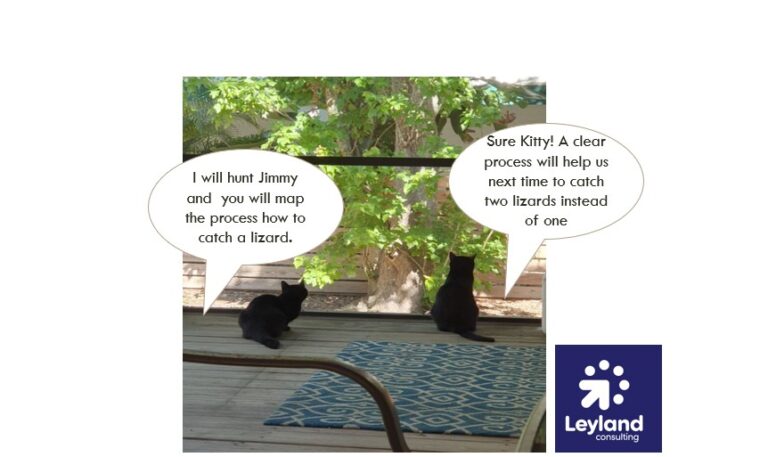
STEP 3. Theory vs Reality
Revise what you have collected. How does the process look now?
Do all elements belong there?
Who helps and who doesn’t? (maybe you can suggest that to the manager )
What have you learned out of working in the team?
Which parts of the process need more time and additional support?
Have you defined risk mitigation in case of any obstacles?
What can be done to avoid it in the future?
Speak with people, be honest, try to look at the problem from very different angles, zoom in and zoom out.
If you want to solve the problem, you can’t be afraid of asking different questions. “No” is also an answer about a company landscape.
STEP 4. Summary
Every Project is a bit different although the core structure might be similar so try to capture as best as possible what have been done.
What have you learned?
What was able to be accomplished and what requires deeper reorganization?
Who can take over and run the process now without your help on a daily basis?
What kind of process you leave?
Have you prepared a manual for people to take over after you?
Good summary of the project will be helpful for the company. They’ve learned what works for them and which tools will be useful in case of new project. You can learn more about your skills and the individual company.
An important step here is asking for feedback about your work as this will help you be better.

STEP 5. Thank you
Even the most successful campaigns need a consultant make sure you do a great job, create structures for others to work, learn and be humble, and if you do a great job, companies would love to have you back.
Be thankful for new opportunities but also make sure you give back the best product you possibly could. Ask for feedback if you haven’t done it yet.

All of us organise some kind of projects /map it all the time. At home, school, or in the backyard.
Not all projects are like LEGO which you can assemble and disassemble without damage.
In real life while assembling and disassembling you will learn that this what works in theory doesn’t make sense in the real life for one company, although another one would be happy to have solution where every second matters and is counted.
Why do I emphasise it?
Because Project Management tools are great, and will definitely help you on every step of the way to organise/ reorganise project or create something new.
What is key is to create something that makes sense for the company which you work for.
If you need help with
Project Management,
Mapping Projects, Reporting,
“Clean Up” before implementing AI of a messy area in your company we are here with years of experience to help you.
We can help you to grow with respect to your company culture and vision.
 Call us,
 Text us,
 Book a Consultation
We work on the global clock
Book a Consultation
We work on the global clock 